
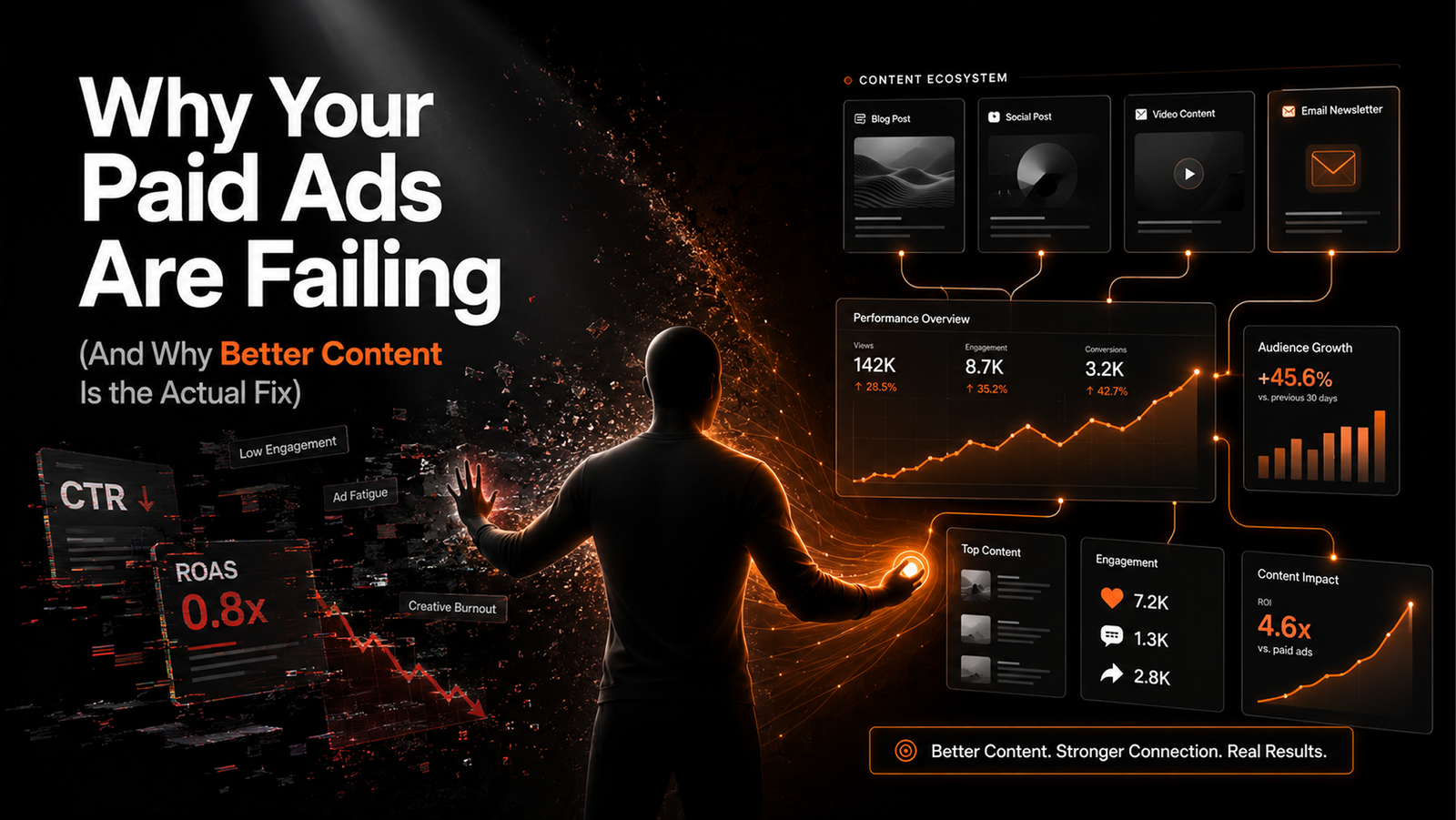
More budget is not the answer. If the foundation is broken, scaling the spend just burns money faster.
That’s the reality most businesses hit somewhere around month three of their Facebook ads not working. The instinct is to assume the campaign needs more – more spend, better targeting, a new creative direction. Sometimes that’s right. But more often, the issue isn’t inside the Ads Manager at all. It’s upstream, in the absence of any meaningful relationship between the brand and the people seeing the ad.
In 2026, this problem will become more expensive to ignore. Cost per lead on Facebook jumped 26% in the past year, and the median CPA across industries now sits at $38.17, with CPM averaging $13.48 – a significant premium to reach audiences in what’s become an extremely crowded auction environment. Running cold traffic into a profile or landing page with no prior trust built is costing more than it ever has, for worse results than it used to produce.
The fix isn’t a better ad. It’s a better system around the ad.
This article covers:
- Why Facebook ads specifically are struggling in 2026 and what changed
- The trust deficit that’s quietly killing conversion rates
- What organic content actually does for your paid campaigns
- How to build a warm audience before you spend a pound on ads
- The retargeting strategy that makes the whole thing work
- What to measure when you combine both
What’s Actually Changed on Facebook in 2026
A few things have shifted simultaneously, and they compound each other.
Meta’s Andromeda algorithm now includes a pre-auction filter that flags repetitive content – meaning running the same creative across multiple ad sets gets penalised before your ad even enters the bidding process. Ad fatigue isn’t just an engagement problem anymore. It actively blocks delivery. When the same audience sees the same creative repeatedly, engagement drops, and Facebook algorithm responds by pulling back on distribution and increasing your CPM.
And on the creative side: any ad creative generated by AI must now be disclosed during setup in Ads Manager. Meta has integrated advanced detection into the ad review flow, and if AI use is detected but the disclosure label is missing, the ad is held for manual review indefinitely.
So the platform itself is harder to work on in 2026. More technical requirements, more competition, higher costs. That’s the environment. Against that backdrop, running cold traffic to a brand nobody recognises is not just inefficient – it’s expensive in a way that compounds monthly.
The Actual Problem: Traffic Is Easy to Buy. Trust Isn’t.
Here’s the thing about Facebook ads. They’re good at one thing: getting your message in front of people. That’s it. They create visibility. They move eyeballs. What they cannot do – at any budget level – is manufacture trust on the spot.
A stranger sees your ad. They land on your page. They have about four seconds to decide whether you’re worth their attention, and they’re making that decision with almost no prior relationship with you. No familiarity. No accumulated proof. Just the ad, and whatever’s on the other side of the click.
The creative is usually fine. The audience is usually the problem. Specifically, the fact that they’ve never encountered the brand before the ad asked them to take action.
What Organic Content Does That Ads Can’t
When we see content it is like something is being sold to us before we even think about buying.. This is not done in a way that is easy to notice. It does not seem like a sales talk that is made to look like a post. The thing is that organic content gives us a feeling about a brand. This brand seems to know what it is talking about. It has helped people like you before. Organic content is really good, at doing this
When someone encounters your content before your ad, the dynamic shifts entirely. The ad isn’t an introduction anymore. It’s a reminder. It’s confirmation of something they already suspected. That psychological difference – from stranger to familiar brand – is what moves conversion rates.
Think about your actions. When did you last click on an ad from a company you had never heard of. Then immediately buy something? That probably does not happen often. Now think about the time a brand you had been following for some time ran a promotion that felt like it was, at just the right moment. Your response is completely different.
That’s what you’re building when you put organic content in front of paid. Not just warm feelings – a lower barrier to conversion, and a cheaper acquisition cost as a result.
Why Facebook Ads Fail Without Content Behind Them
The pattern almost always looks the same.
A business sets up campaigns, targets a cold audience, writes decent copy, and waits. Clicks come in. The cost per click looks acceptable. But conversions are thin. The cost per acquisition climbs. The team adjusts targeting. Tests new creative. Increases the budget hoping more volume covers the poor conversion rate. The numbers don’t improve materially.
The diagnosis, in most of these cases: no organic foundation. The business was running ads to people who had never heard of them, into a profile or landing page that hadn’t been built to convert cold traffic. Every element in that system had to work perfectly to compensate for the absence of prior trust – and systems that require perfection at every stage rarely perform consistently.
By 2026 the way companies do advertising will have to change. They can not just throw a lot of Facebook ads there and hope something works. This “spray and pray” approach is not good enough anymore. Companies need to make a plan and build a system that takes people through a process rather than just showing them one ad and expecting them to buy something.
The five common reasons why Facebook ads do not work well in 2026 are:
* No foundation. This means the first time someone hears about a company is when they see a Facebook ad asking them to buy something. Facebook ads like this do not work because people do not know the company and they do not trust the company. They have no reason to buy something from the company. Facebook ads need to be part of a plan, where people can get to know a company and its products before they are asked to buy something. This is why Facebook ads, with no foundation, are a problem.
Weak profile or landing page – someone clicks through and can’t quickly establish what they’d be getting, why this company is credible, or what happens next. The click was paid for. The page lost the lead.
Ad fatigue with no creative refresh – the same audience has seen the same ad too many times. Engagement has dropped. The algorithm has responded by cutting distribution and raising CPMs. The campaign quietly dies while the budget keeps running.
Selling to cold traffic at the bottom of the funnel – asking someone who’s never heard of you to book a call or make a significant purchase. The task is too large for the relationship stage.
No retargeting – every viewer is treated as a cold stranger regardless of whether they watched a video, visited the website, or engaged with previous content. The most valuable audience in the account is being ignored.
Building the Content Foundation Before the Ad Spend
The businesses consistently getting strong results from Facebook ads in 2026 are not running better ads. They’re running better systems. The content comes first, the ads amplify what’s already working.
Top of funnel – make yourself recognisable first.You should write posts and make short videos that talk about a problem your ideal client is dealing with right now. You need to show them that you really understand what is going on in their world. This is not about making a video that everyone will see. It is about being seen by the people often enough so when you show them an ad it feels like the next thing they should do, not something that is bothering them.
Middle of funnel – build the case. Case studies that show real client situations and outcomes. Posts that handle the objections a prospect carries quietly into every buying decision. Content that answers “have they done this for businesses?” and “what happens if it doesn’t work?” before anyone has to ask.
Bottom of funnel – make the ask obvious. Testimonials with specific detail. Results with real numbers. Offer-specific content where the next step is clear and low-friction. This is where organic and paid overlap most directly – a prospect who’s consumed your middle-funnel content is genuinely ready to be retargeted with a direct offer.
None of this has to be produced at scale. Three pieces of content a week, targeted at a specific niche, over eight to twelve weeks, builds more audience trust than most businesses think is possible without a paid media budget.
The Retargeting System That Changes the Economics
This is the part most businesses skip entirely, and it’s where the biggest difference in ad performance actually lives.
Video view retargeting is the most underused tactic in most Facebook accounts. Here’s the mechanic. You publish a short, genuinely useful video organically – or run it as a low-cost awareness ad. It reaches people. Meta logs how much of it each person watched: 25%, 50%, 75%, 95%. You build custom audiences based on those thresholds.
The people who watched 75% or more are not cold. They stopped scrolling, paid attention, and stayed with the content past the point where most people had already moved on. That’s the intent. Real intent – far more reliable than an interest category or a lookalike audience.
You retarget those people. Not with more educational content. With a direct offer. A case study. A “book a call” ad. Because they already know the context, the conversion rate on those ads is dramatically higher than anything you’d get running the same offer to a cold audience.
Re-engagement campaigns targeting warm audiences typically achieve 60–70% lower cost per re-activation compared to acquiring new users through cold prospecting. Run the numbers on your current campaign against that gap and the case for building a warm audience first becomes very obvious.
The Full Funnel – Simply Put
Stage one: organic content reaches the right people. They encounter your brand, find it useful or relevant, and move on. The algorithm notes the engagement.
Stage two: they see more content. The familiarity builds. They start to associate your name with a specific kind of expertise or outcome. No active selling is happening.
Stage three: a retargeted ad appears. It’s relevant because it’s based on exactly what they’ve already engaged with. The offer makes sense in context.
Stage four: they convert. Not because the ad was particularly clever, but because the relationship was already there when the ask arrived.
Most businesses only run stage three and wonder why the economics don’t work. The ad is fine. The system around it is missing.
Profile and Landing Page – The Last-Inch Problem
One thing that doesn’t get enough attention: the organic content and retargeting strategy only works if, when someone clicks through, the page does its job.
A paid click is one of the most expensive micro-moments in digital marketing. If someone lands on a profile with a vague bio, no clear positioning, and no obvious next step – or a landing page that takes twelve seconds to load and leads with generic copy – the lead disappears. The ad budget paid for the click. The page threw the lead away.
Before you spend money on a paid campaign you need to make sure your profile or landing page is good enough. It has to pass a test. Someone who does not know you should be able to look at it and understand what you do, who you are trying to help and what they should do next. They should be able to figure all of this out in under five seconds. If they can not do that you need to fix your profile or landing page. This will make every paid campaign better. You do not have to change who you are showing the campaign to or the campaign itself. Just fix your paid campaign profile or landing page.
What to Actually Measure
The metrics that feel good to report – reach, impressions, click-through rate – are not the metrics that determine whether the strategy is working.
When combining organic content with paid ads, the numbers worth tracking are:
Cost per qualified lead, don’t use cost per lead. A cheap lead that never converts is not a win. The qualification matters as much as the volume.
Video view retention rate on organic content. How long people are watching tells you whether the content is building the right audience for retargeting. Low retention means a smaller, lower-quality retargeting pool.
Retargeting conversion rate compared to cold traffic conversion rate. If the gap isn’t significant, either the retargeting audience isn’t warm enough or the offer needs work.
Customer acquisition cost across the whole funnel – including the time and production cost of organic content, not just the ad spend. The real comparison is total cost per client acquired, not just what the Ads Manager reports.
ROAS measured over the right window. Some purchase decisions take weeks. Attribution windows that are too short undercount conversions and make profitable campaigns look like failures.
Final Thoughts
Facebook ads aren’t broken. The conditions around running them profitably have just become more demanding – higher costs, more competition, a platform that penalises lazy creative and rewards genuine engagement signals.
The businesses that are getting results are not the ones with the biggest budgets. The businesses that are getting results are the ones that built warm audiences before they ran the ads for the businesses. The businesses that are getting results created content that answered the right questions at each stage of the buying journey for the businesses. The businesses that are getting results also retargeted people based on actual demonstrated interest in the businesses rather than just making demographic guesses about the people who may be interested in the businesses.
- Retargeting warm audiences costs 50-70% less than cold prospecting – the math alone makes content worth investing in.
- Ad fatigue now actively limits delivery, not just engagement – creative refresh and audience warmth are non-negotiable.
- The five-second landing page test will improve conversion rates faster than any targeting tweak.
- The full funnel – organic discovery, trust building, retargeting, conversion – outperforms any single-stage paid approach.
Ads are accelerators. Content is the fuel. Running ads without content is expensive. Running them together is how the economics actually start to make sense.
Want to grow your social media presence? Book your 7 days free trial.